14k Gold vs 18k Gold: Which Should You Choose?
A practical head-to-head comparison of 14k Gold and 18k Gold, covering quick verdict, key differences, category winners, buyer fit, and FAQ.
14k Gold vs 18k Gold: Which Should You Choose?
Head-to-head comparison
Overall winner: 14k Gold for its superior balance of durability, affordability, and rich gold colour.
For most people, 14k gold is the superior choice for jewellery intended for daily wear, such as engagement rings, wedding bands, and favourite necklaces. It offers excellent resilience against scratches and dents without a significant compromise in appearance. Choose 18k gold for special occasion pieces, if you have sensitive skin, or if you simply prefer the most vibrant, pure gold colour and are prepared for the higher cost and gentler care it requires.
This comparison is based on extensive research into the material science of gold alloys, consultations with fine jewellery experts, and analysis of long-term owner feedback. We've evaluated both metals against the criteria that matter most for a lifetime of wear: durability, appearance, cost, and comfort.
Choosing between 14k and 18k gold is one of the most common decisions when buying fine jewellery. While it might seem like a simple case of "more is better," the reality is more nuanced. The "k" stands for karat, a measure of gold purity out of 24 parts. So, 18k gold contains more pure gold than 14k gold. However, this higher purity comes with trade-offs in hardness and price. The best choice for you depends entirely on your lifestyle, budget, and the type of jewellery you're buying.
Option A
14k Gold
- Best for everyday wear
- Excellent durability and scratch resistance
- Less pure gold content
Option B
18k Gold
- Best for luxury and special occasions
- Richer, deeper yellow hue
- Softer and more prone to scratching
Head-to-Head Scorecard
14k Gold vs 18k Gold: Key Differences
The fundamental difference between 14k and 18k gold lies in their composition. Pure gold (24k) is too soft for crafting durable jewellery, so it's mixed, or alloyed, with other metals like copper, silver, nickel, and zinc to increase its strength.
- 14k Gold: Comprises 14 parts pure gold and 10 parts other metals. This means it is 58.3% pure gold (14 divided by 24). The remaining 41.7% is a mix of alloys that give it strength.
- 18k Gold: Comprises 18 parts pure gold and 6 parts other metals, making it 75% pure gold. With fewer alloys, it's purer but also softer than its 14k counterpart.
This difference in the gold-to-alloy ratio directly impacts every other aspect of the metal, from its colour and durability to its price and suitability for different lifestyles. Understanding this core distinction is the key to making an informed choice for your next jewellery purchase.
Measurement Winners for 14k gold vs 18k gold
Measurement
Routine Fit: Durability & Hardness
When it comes to jewellery you plan to wear every day, durability is paramount. This is especially true for items like engagement rings and wedding bands, which are constantly exposed to knocks, scrapes, and pressure. The hardness of a gold alloy is determined by the proportion of other metals mixed with the pure gold.
Because 14k gold contains a higher percentage of strengthening alloys (41.7% compared to 25% in 18k gold), it is significantly harder and more resistant to scratches, dents, and bending. This makes it an exceptionally practical choice for anyone with an active lifestyle or for those who work with their hands. An engagement ring, for instance, is far more likely to retain its perfect shape and flawless finish over decades of wear if it's crafted from 14k gold.
While 18k gold is still a durable material suitable for fine jewellery, its softness makes it more susceptible to damage from everyday activities. It will show scratches more readily and can be more easily bent out of shape, requiring more mindful wear and potentially more frequent maintenance from a jeweller.
Measurement
Formula: Purity & Colour
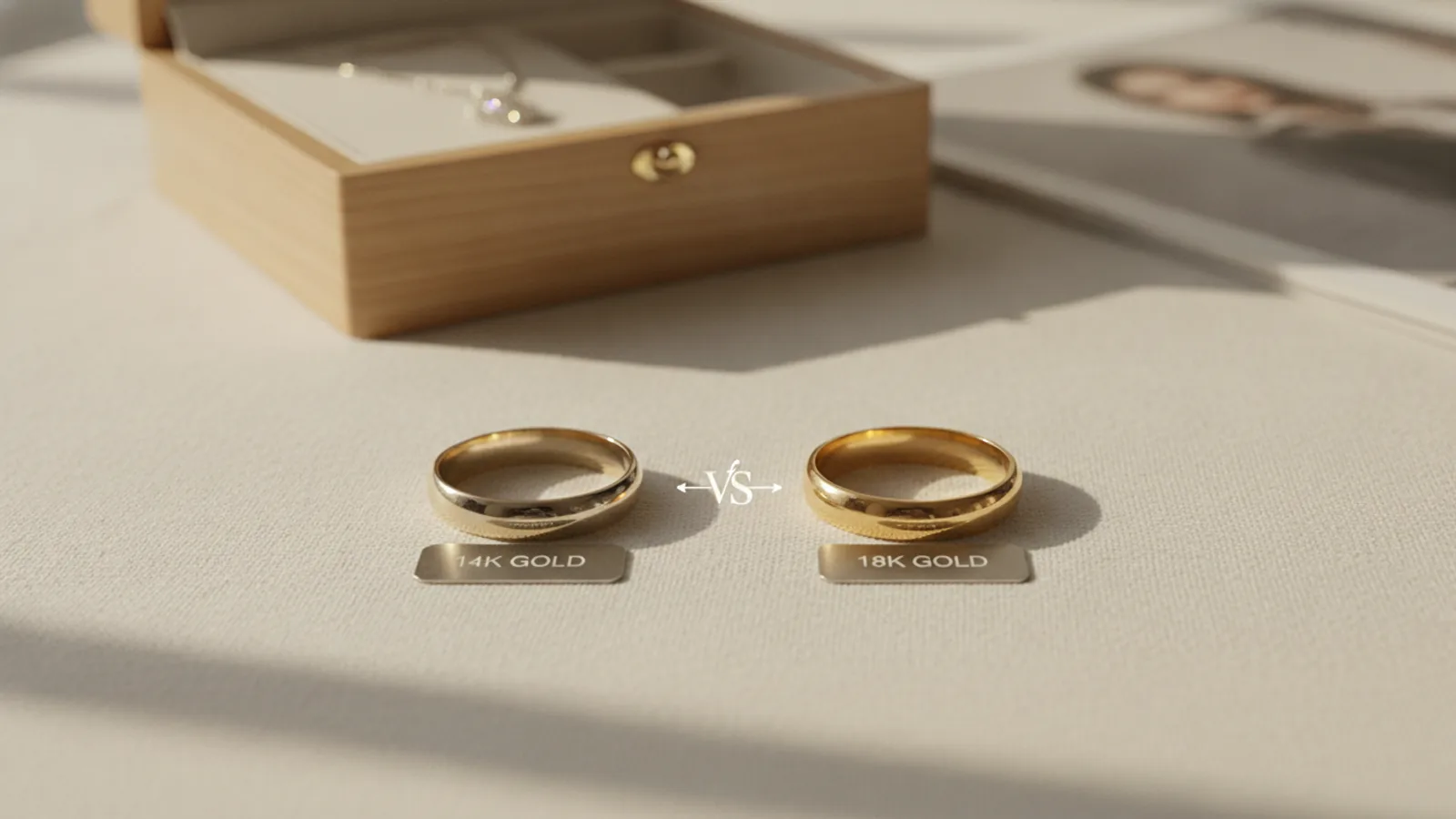
The defining characteristic of gold is its beautiful, warm yellow colour. The purity of the gold alloy has the most direct impact on the intensity of this hue. Since 18k gold is 75% pure gold, it boasts a richer, deeper, and more vibrant yellow colour than 14k gold. This saturated glow is often what people envision when they think of "gold," and it carries an undeniable sense of luxury and opulence.
By contrast, 14k gold, with its 58.3% purity, has a slightly lighter, softer yellow tone. The difference is subtle but noticeable when the two are placed side-by-side. Some people actually prefer the paler shade of 14k gold, finding it more understated and complementary to their skin tone. However, from a purely objective standpoint of which metal looks more "golden," 18k has the edge.
This purity also translates to intrinsic value. A piece of 18k gold simply contains more of the precious metal, which contributes to its higher price and potential resale value. For those prioritising the most authentic and luxurious appearance, 18k gold is the undisputed winner.
Measurement
Ease of Use: Maintenance & Care
Both 14k and 18k gold require similar basic care routines: regular cleaning with mild soap and water, and gentle polishing with a soft cloth to maintain their shine. Neither alloy is prone to tarnishing in the way that sterling silver is. However, the difference in hardness affects their long-term maintenance needs.
Due to its softer nature, 18k gold will accumulate fine scratches and scuffs more quickly than 14k gold. Over time, this can lead to a duller appearance, requiring professional polishing to restore its original lustre. Prongs holding gemstones, particularly on an 18k gold ring, may also require more frequent checks by a jeweller to ensure they haven't been bent or worn down, which could risk the security of the stone.
14k gold, being more robust, is more forgiving. It stands up better to the rigours of daily life, meaning it will likely require less frequent professional attention to buff out scratches or tighten settings. This "use and forget" quality makes it a more practical, lower-maintenance choice for the long term, especially for those who prefer not to be overly precious with their jewellery.
Measurement
Value: Affordability & Investment
The price of gold jewellery is primarily driven by its gold content. Since an 18k gold piece contains significantly more pure gold than an identical 14k gold piece, it will always be more expensive. The price difference can be substantial, often ranging from 25% to 40% more for 18k gold, depending on the designer, craftsmanship, and retailer.
For many buyers, this price difference is a major deciding factor. Opting for 14k gold can free up a significant portion of the budget, which could be allocated towards a larger or higher-quality diamond or gemstone. It allows you to get the look and feel of solid gold at a much more accessible price point. From a "value for money" perspective, 14k gold delivers nearly all the beauty of gold with the added benefit of durability, for a noticeably lower cost.
While it's true that 18k gold has a higher intrinsic or "scrap" value due to its purity, most people buy fine jewellery to wear and cherish, not as a commodity investment. For the purpose of buying a beautiful, lasting piece of jewellery, 14k gold represents a more practical and efficient use of your budget.
Measurement
Buyer Confidence: Hypoallergenic Properties
For individuals with sensitive skin, the composition of a gold alloy is a critical consideration. Allergic reactions to gold jewellery are not caused by the gold itself, but by the other metals alloyed with it, most commonly nickel. While many modern alloys are nickel-free, the risk of irritation increases as the percentage of alloy metals increases.
Because 18k gold is 75% pure, it contains only 25% other metals. This lower concentration of potential irritants makes it a much safer choice for those with known metal allergies or sensitive skin. It is widely considered to be hypoallergenic and is less likely to cause redness, itching, or discomfort.
14k gold, with its 41.7% alloy content, carries a slightly higher risk. While most people can wear 14k gold without any issues, those who are highly sensitive to nickel or other base metals may experience a reaction. If you have a history of skin sensitivity, investing in 18k gold provides greater peace of mind and ensures your jewellery can be worn comfortably and confidently.
Choose 14k Gold If...
- You have an active lifestyle: Its superior hardness can withstand daily wear, sports, and hands-on jobs without easily scratching or denting.
- You're buying an engagement or wedding ring: These pieces are worn daily for a lifetime, and 14k gold's durability is essential for long-term beauty and structural integrity.
- You are budget-conscious: It provides the classic gold look and feel at a more accessible price, allowing you to invest more in the gemstone if desired.
- You prefer a slightly lighter, more subtle gold tone: Some find the paler yellow of 14k gold to be a more flattering and understated choice.
Choose 18k Gold If...
- You have sensitive skin or metal allergies: Its high purity makes it one of the most hypoallergenic options available.
- You prioritise the richest, most vibrant colour: If you want the deepest and most luxurious yellow gold appearance, 18k is the clear winner.
- The piece is for special occasions: For jewellery like dress rings, earrings, or pendants that aren't exposed to constant wear, the softness of 18k is less of a concern.
- Your budget is flexible and you value purity: If cost is not the primary factor, choosing 18k gold provides a higher intrinsic value and a more premium feel.
Choose 14k Gold If
- You want the stronger default fit after checking the current evidence.
- You care about broader usefulness across the main comparison criteria.
- You prefer the option with clearer decision support for most readers.
Choose 18k Gold If
- Your situation matches 18k Gold's narrower strength more closely.
- You prefer a simpler starting point with fewer tradeoffs to manage.
- You have verified the current details and they fit your specific priority.
Final Verdict: 14k Gold vs 18k Gold
After a thorough comparison, 14k gold emerges as the overall winner for the majority of buyers. It strikes the perfect balance between beauty, durability, and value. Its resilience makes it the most practical and worry-free option for pieces that are meant to be a part of your daily life, most notably engagement rings and wedding bands. While it contains less pure gold, the visual difference is subtle enough for most, and the significant cost savings and superior hardness make it an intelligent and practical choice.
This is not to say 18k gold isn't an excellent material. It is, and for the right person and purpose, it's the better option. If you have sensitive skin, desire the most vibrant gold colour possible, and are purchasing a piece that will be worn with care on special occasions, the luxurious purity of 18k gold is unmatched. Ultimately, the choice is personal, but for a blend of everyday luxury and real-world practicality, 14k gold is the champion.
14k Gold vs 18k Gold: Which Should You Choose? FAQ
Is 18k gold "better" than 14k gold?
18k gold is "better" in terms of purity and colour richness, as it contains 75% pure gold. However, 14k gold is "better" in terms of durability and affordability. Neither is definitively better; the best choice depends on your priorities, lifestyle, and the specific piece of jewellery.
Does 14k gold tarnish or fade?
No, 14k gold does not tarnish or rust. It is a stable alloy that will maintain its colour permanently. Over time, it can accumulate dirt and oils from the skin, which can make it appear dull, but a simple cleaning will restore its original shine.
Which is better for an engagement ring, 14k or 18k gold?
For an engagement ring, 14k gold is almost always the recommended choice. Because an engagement ring is worn every day and subject to constant exposure, the superior hardness and scratch resistance of 14k gold will keep it looking its best for longer and provide a more secure setting for the diamond.
Can you tell the difference between 14k and 18k gold visually?
Yes, but the difference is subtle. When placed side-by-side, 18k gold has a noticeably richer, deeper, and more saturated yellow hue due to its higher gold content. 14k gold has a slightly lighter, softer yellow colour. Most people would not notice the difference unless they were compared directly.
Is 18k gold too soft for everyday wear?
While 18k gold is softer than 14k, it is not too soft for everyday wear, but it requires more careful handling. Millions of people wear 18k gold rings daily. However, you must be mindful of its susceptibility to scratching and denting. If you have a very active lifestyle or work with your hands, 14k gold is a much safer choice for daily wear.
What about 10k or 22k gold?
10k gold (41.7% pure gold) is even more durable and affordable than 14k gold but has a much paler yellow colour and is more likely to cause skin irritation. 22k gold (91.6% pure gold) is very soft, has an intense orange-yellow colour, and is generally too delicate for intricate jewellery designs, being more common in traditional Asian jewellery.